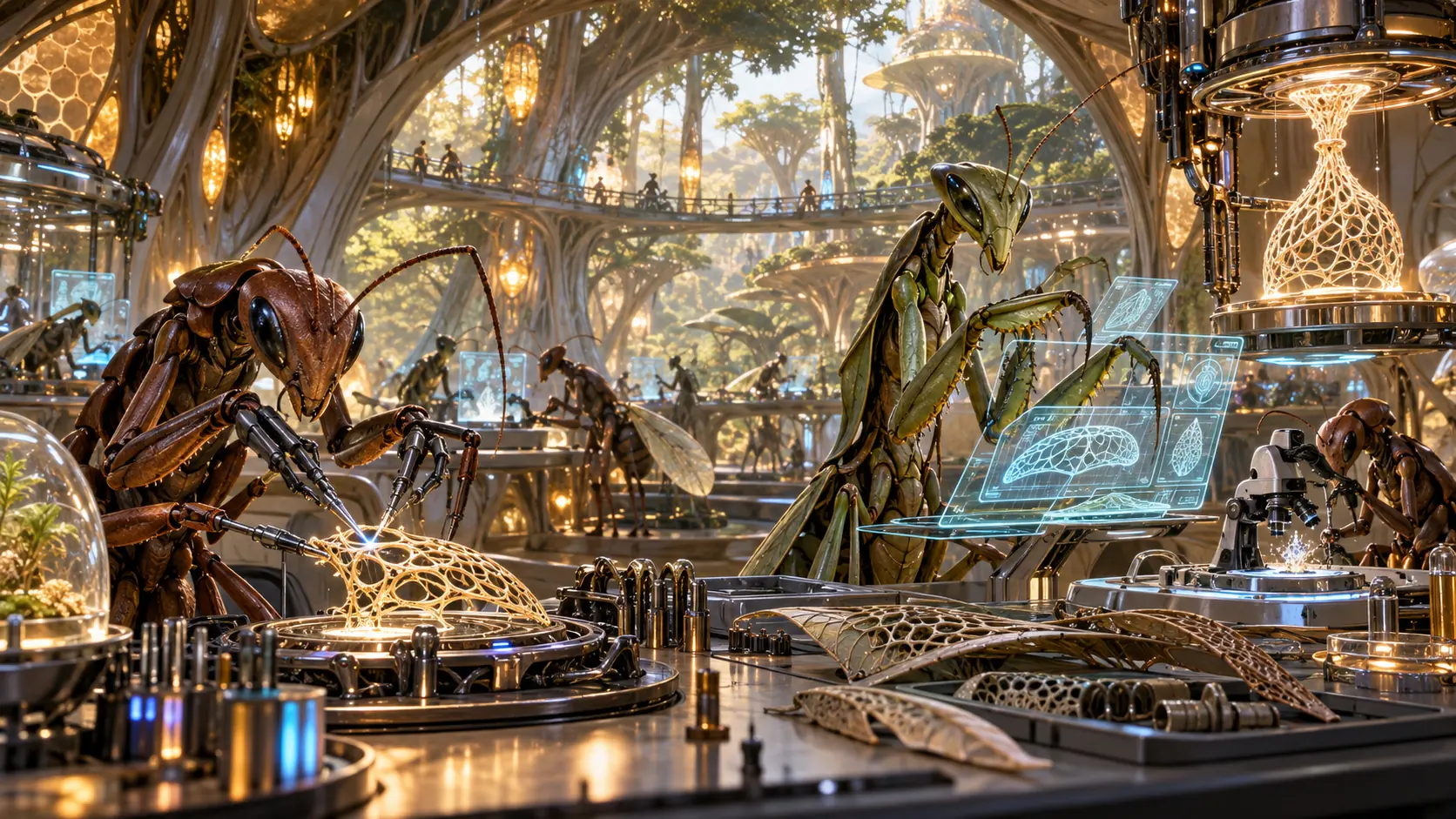
Bodies engineered by evolution
Large arthropod sophonts require more than abundant oxygen. Active respiratory pumping, efficient internal circulation, composite exoskeletal materials, segmented load paths, controlled molting, and thermal regulation work together. Specialized limbs provide locomotion, anchoring, sensing, and precise manipulation. Their tools and buildings begin with these capabilities instead of forcing an insect-shaped body into equipment designed for a human operator.
Distributed but personal intelligence
Chemical signals, vibration, posture, touch, sound, and electronic translation can operate simultaneously, giving Conclave communication unusual density. Shared networks preserve technical knowledge and coordinate large projects, but they do not replace personal judgment. Citizens can disagree with policy, refuse orders, change occupations, form relationships, create art, conduct research, and belong to rival schools of thought. Collective capacity and individual agency coexist.
Industry becomes living infrastructure
Arthropod engineering favors cultivated materials, modular repair, chemical processing, environmental sensing, and systems maintained by many specialists. A city may grow structural layers while still using machines, computation, standards, and formal inspection. Developmental castes are not social destiny: institutions determine training, authority, mobility, and rights. The resulting civilization is technologically sophisticated, politically contested, and capable of both extraordinary continuity and catastrophic error.