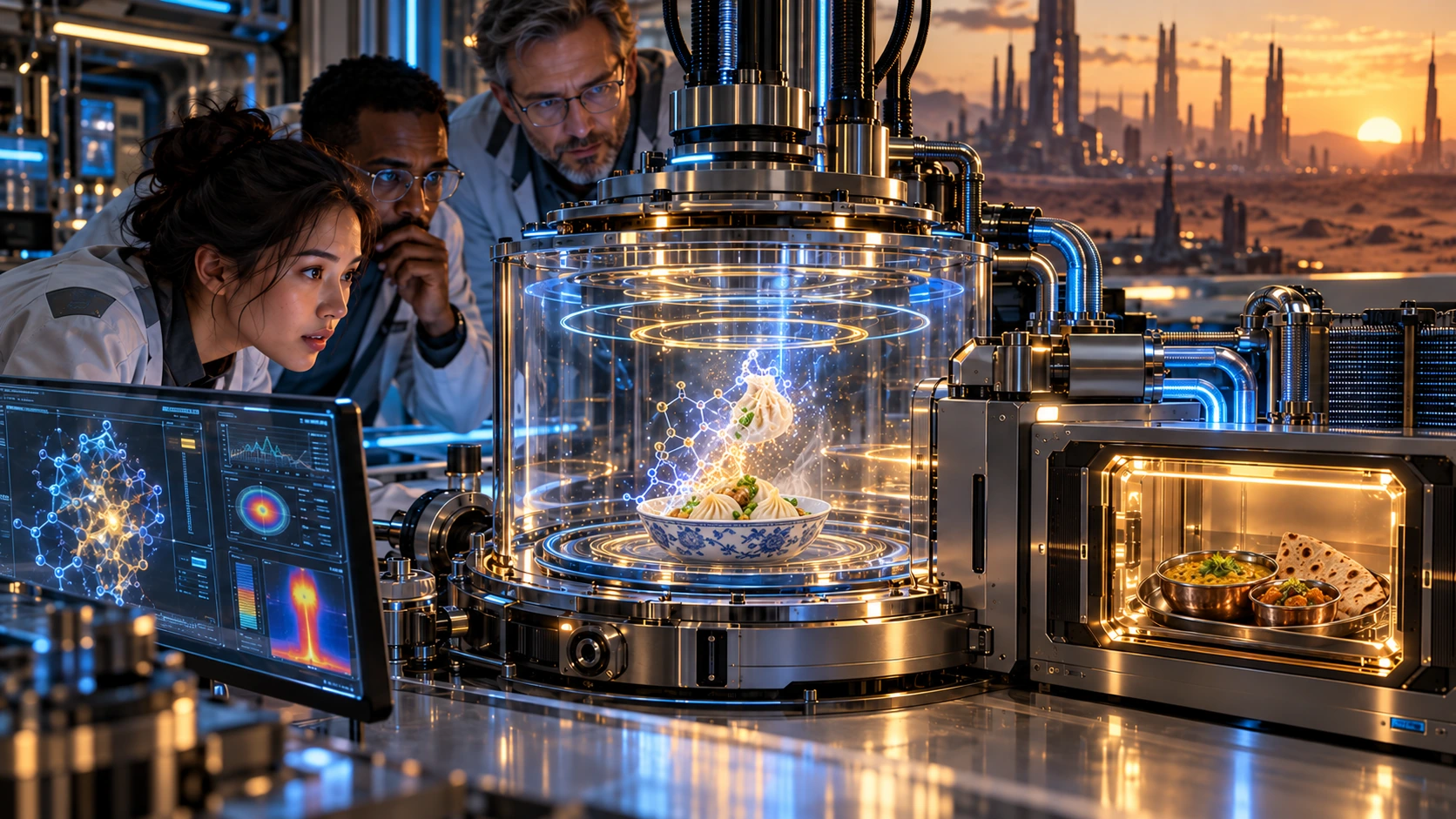
New physics begins in Book I
The first novel pursues a genuine Nano Replicator. Matter-reconstruction experiments and independent verification are central scientific work, alongside the urgency of a world facing interconnected food failure.
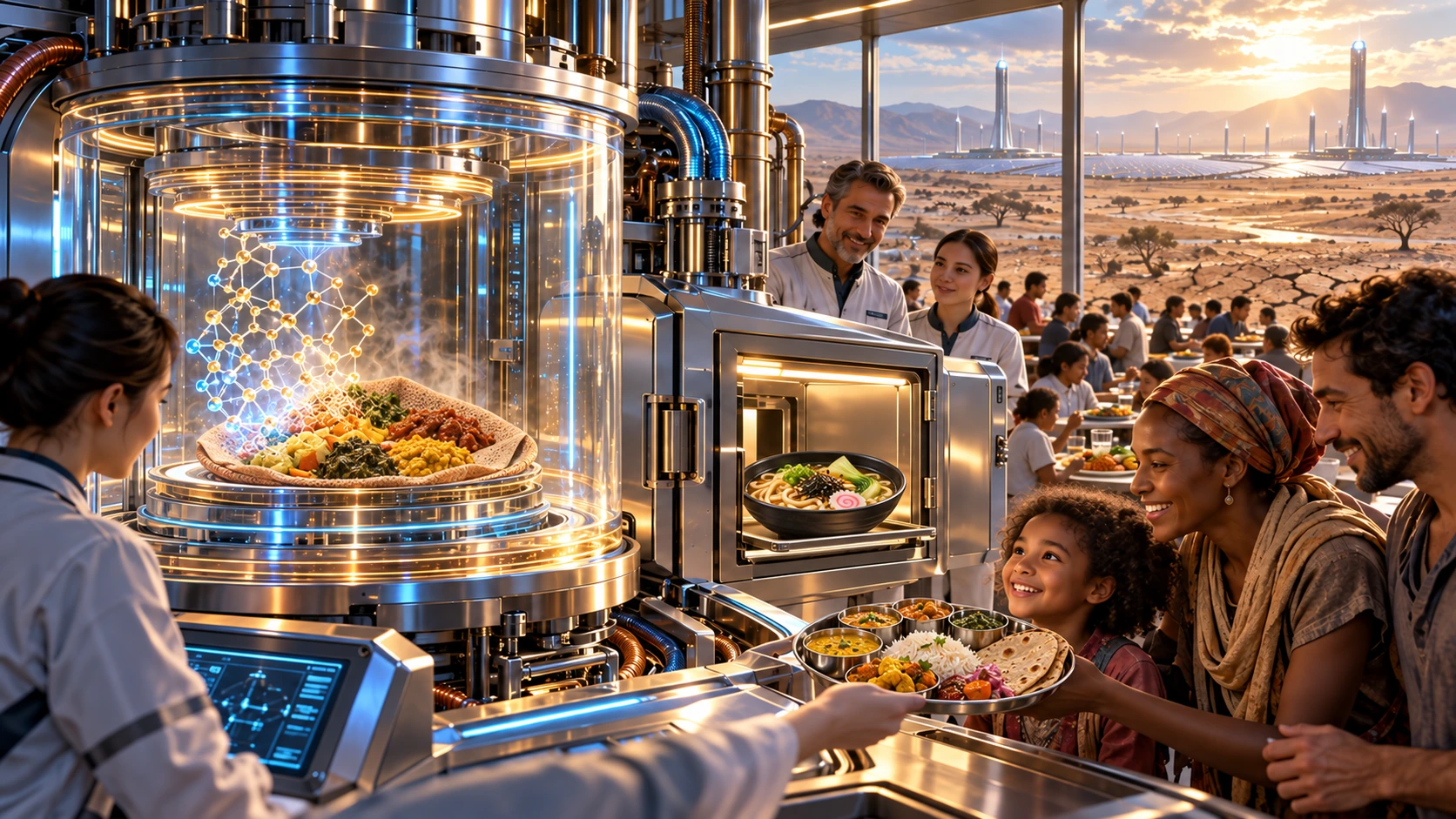
NanoFeast’s defining breakthrough is advanced matter reconstruction, progressing toward energy-to-matter food creation in a 22nd-century storyworld. Book I puts meaningful new-physics research and experimental milestones at the center of the drama. The X1–X10 development path expands capability, independence and scale rather than making an agricultural food printer the final solution.

Each page reveals a different part of the same story. The active area is highlighted below.
From science to social impact
Nutrition, health and food systems
Farms, soils and food security
Clean water for people and places
Relief, resilience and dignity
Markets, work and shared prosperity
Power, rights and accountability
People, culture and a better tomorrow
These public summaries preserve the current story architecture without turning the site into a technical manual.
The first novel pursues a genuine Nano Replicator. Matter-reconstruction experiments and independent verification are central scientific work, alongside the urgency of a world facing interconnected food failure.
Quantum sensing, a holographic coordinate stream, the TWAM field array and the Molecular Integrator connect material information with precisely controlled reconstruction. Energy-to-mass conversion is the exceptional frontier within that architecture.
Successive systems reduce dependence on conventional inputs while improving elemental sourcing, assembly, energy conversion, throughput and resilience. Generation labels do not impose an arbitrary book-by-book ceiling on discovery.
Creating food through energy-to-matter conversion demands extraordinary energy capability and genuinely new fictional physics. Power delivery, conversion losses, heat removal and mass accounting remain major research and story constraints.
Control of a reconstruction field does not by itself prove that its output is safe. Composition, nutrition, allergens, contaminants, structural integrity and process evidence determine whether food may be released.
Deployable hubs and community installations bring food creation to regions where harvests and livestock have failed. Reliable power, thermal management, service and local authority sustain the capability.